Back to home

2040 VISION

The City After Friction

By 2040, cities will no longer function as static environments built around centralized infrastructure, passive land use and human-operated systems.

They will behave more like living networks — adaptive, autonomous and continuously optimizing themselves in real time.

The urban age is entering its next operating system.

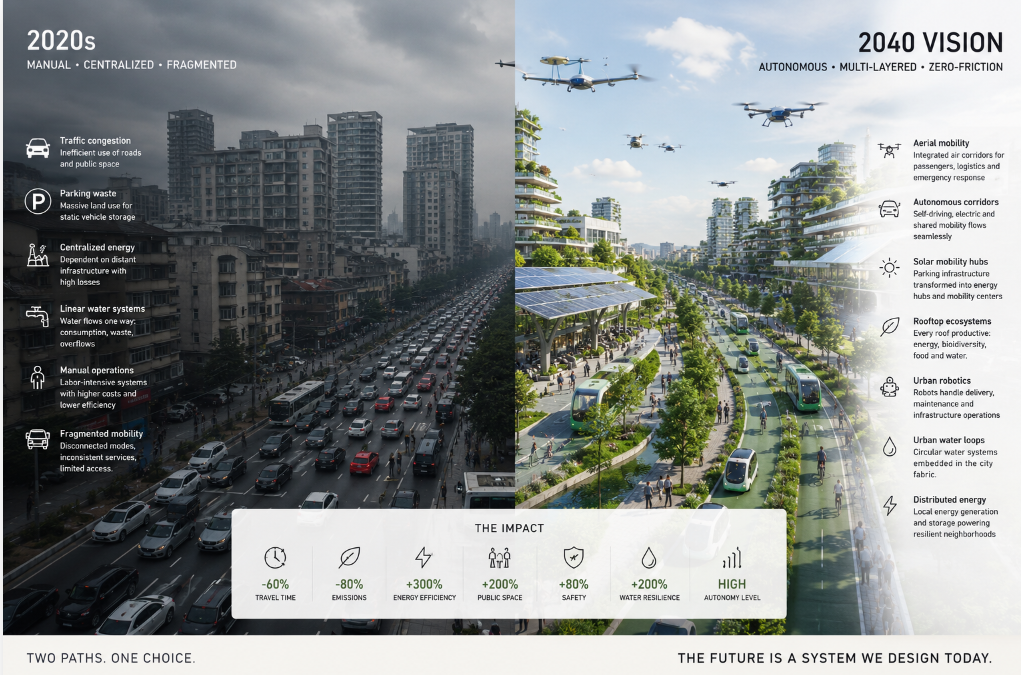
Side-by-side comparison: the manual, centralized 2020s city versus the autonomous, multi-layered 2040 vision

01

Infrastructure Becomes Intelligent

Roads no longer simply move vehicles.
Buildings no longer simply consume energy.
Parking lots no longer sit idle beneath the sun.

Every major urban surface becomes productive.

Rooftops generate power, collect water and support biodiversity.
Parking infrastructure operates as distributed energy networks.
Transit corridors dynamically adapt to traffic demand.
Public infrastructure responds to weather, energy loads and pedestrian movement autonomously.

The distinction between digital systems and physical infrastructure begins to disappear.

Cities become programmable environments.

EPILOGUE

2040 Is Not The End State

The most important shift is not technological.

It is philosophical.

Humanity is beginning to redesign cities not only for economic growth — but for resilience, adaptability and long-term planetary coexistence.

The future city is no longer static.

It learns.

It adapts.

It coordinates.

It produces.

It regenerates.

And by 2040, the cities that understand this transformation earliest may redefine how civilization itself operates in the century ahead.