INSIGHTS
The systems shaping the next urban era
Six converging infrastructure layers redefining how cities produce energy, move people, manage water and operate at scale.
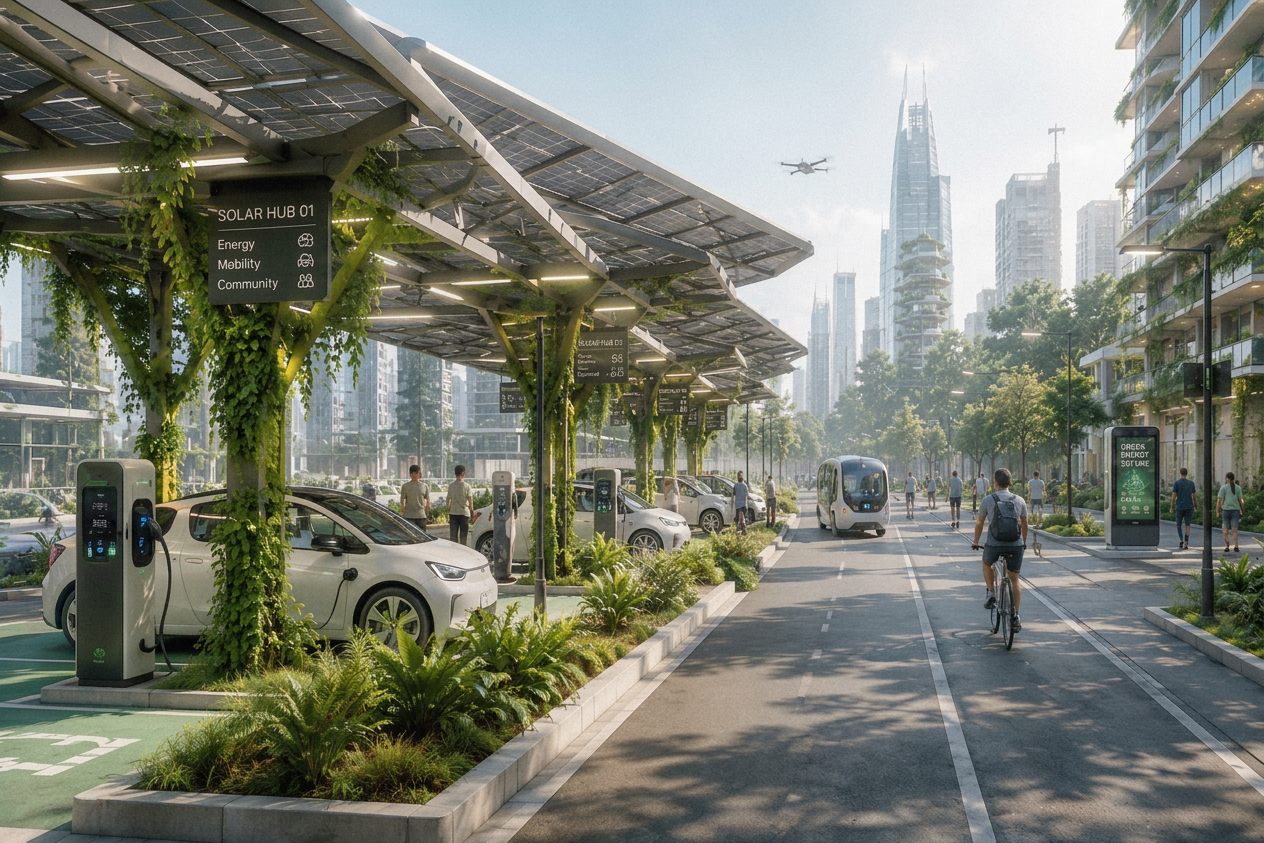
Solar Mobility Hubs
Transforming Parking Infrastructure Into Distributed Energy Systems
Parking lots are among the largest underutilized surfaces in modern cities. Originally designed for passive vehicle storage, they are now emerging as critical nodes within the future urban energy and mobility ecosystem.
Solar mobility hubs combine solar canopies, EV charging, battery storage, smart energy management and climate-adaptive urban design into a single piece of multi-functional infrastructure. These systems transform asphalt-heavy environments into productive urban assets capable of generating electricity, supporting electric mobility, reducing heat island effects and improving public space simultaneously.
As cities accelerate electrification and decentralized energy production, solar mobility hubs are becoming an increasingly important layer within distributed urban infrastructure networks.
CORE SYSTEMS
- Solar canopies
- EV charging infrastructure
- Battery energy storage systems (BESS)
- Vehicle-to-grid (V2G) integration
- Smart grid coordination
- Urban cooling and shading
- Autonomous mobility integration
- Rainwater harvesting systems
WHY IT MATTERS
Urban parking infrastructure occupies enormous amounts of valuable land while remaining economically passive for much of the day. By integrating renewable energy generation and mobility services directly into parking environments, cities can increase local energy resilience while improving land productivity and reducing emissions.
Solar mobility hubs also support the transition toward electric and autonomous transportation by providing distributed charging infrastructure closer to where vehicles naturally dwell.
2030–2040 OUTLOOK
Over the coming decades, parking infrastructure is expected to evolve into energy-positive mobility platforms integrated with autonomous fleets, district batteries and AI-managed urban energy systems. Parking lots will increasingly function as flexible urban utility layers rather than static storage spaces for vehicles.