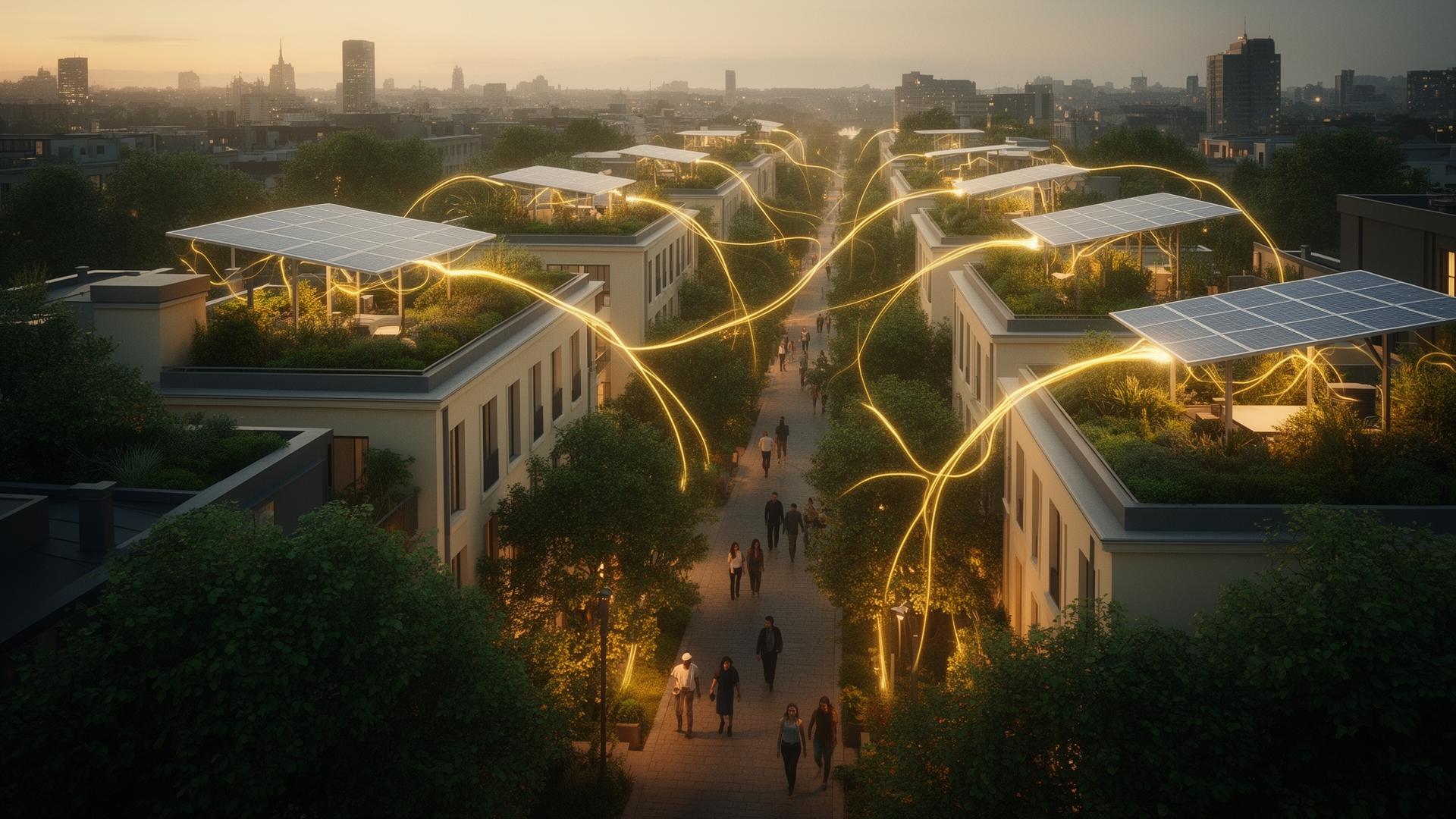
A City Too Complex to Run by Hand
The productive city creates a beautiful problem. Once every roof generates power, every canopy catches water, every vehicle is a battery on wheels and every district trades surplus in real time, you have a system with millions of moving parts settling decisions every second. No control room of humans could ever manage that — the numbers are too large, the timescales too fast, the interdependencies too dense.
The old city was simple enough to run by hand because it was mostly passive: pipes carried, wires fed, and almost nothing made decisions. The productive city is the opposite. It is alive with millions of tiny choices, and that is precisely why it needs a coordination layer that humans cannot provide. AI is not a feature bolted onto the productive city. It is the thing that makes a productive city possible at all.
AI is not a feature bolted onto the productive city. It is the thing that makes a productive city possible at all.
From Reacting to Anticipating
A nervous system does more than carry signals — it predicts. The productive city, wired with intelligence, stops merely reacting to events and starts anticipating them. A building that sees a storm forming and fills its cisterns the night before. A district that reads a heatwave coming and pre-cools its most vulnerable streets, pooling shade and stored power before anyone feels the heat. A grid that knows tomorrow's demand curve and quietly arranges today's surplus to meet it.
None of this requires a human to notice, decide and act in time — which is fortunate, because by the time a human noticed, it would be too late. The intelligent city's deepest gift is foresight: it moves the moment of decision earlier, ahead of the crisis instead of behind it. A city that anticipates is a city that protects.
The intelligent city moves the moment of decision earlier — ahead of the crisis instead of behind it.
The Loop You Can't Ignore
There is a circularity here too honest to skip. AI needs energy — vast and growing rivers of it, poured into the data centres that think on the city's behalf. And energy, in the productive city, is made by the same surfaces the AI coordinates. The intelligence runs on the power the rooftops generate; the rooftops are optimised by the intelligence. Each feeds the other.
This is why energy and intelligence cannot be discussed apart — and why the question of ownership cuts so deep. Whoever owns the energy can run the intelligence; whoever runs the intelligence can shape the city. Concentrate both in a few hands and you get a city governed from the outside. Distribute both — energy across millions of surfaces, intelligence across open and accountable systems — and you get a city that governs itself. The productive city's bet is distribution, on both layers at once.
Whoever owns the energy can run the intelligence; whoever runs the intelligence can shape the city.
A Servant, Not a Sovereign
The fear is obvious, and it deserves a straight answer: a city that runs itself sounds like a city that runs over the people in it. It must not. The whole point of the productive city is human wellbeing — time returned, air cleaned, comfort restored, energy made abundant and fair. The intelligence exists to serve those ends, not to optimise people out of the loop.
That means designing it as a servant, not a sovereign: transparent in what it does, accountable for its choices, and always answerable to the residents whose lives it shapes. A good urban AI is felt the way good plumbing is felt — as the quiet absence of problems, never as a power presiding over you.
The measure of success is not how clever the system is. It is whether the people in the city are freer, safer and better off because of it. Intelligence in the service of dignity, or it isn't worth building.
A good urban AI is felt the way good plumbing is — as the quiet absence of problems, never as a power presiding over you.
When the City Becomes a Partner
Here is the strangest, most hopeful horizon — the part we don't yet have words for. When every surface produces and every system can talk to every other one, the city stops being a thing we maintain and becomes something closer to a partner we live alongside. It senses what its people need and arranges itself to provide it. It heals small failures before they spread. It learns the rhythm of its neighbourhoods and moves with them.
We have never lived in a city that was, in any real sense, awake. We are about to. And just as someone in 1900 had no word for what a connected machine in your pocket would feel like, we have no word yet for what it is to share your city with an intelligence woven through its every surface — quietly producing, balancing and caring, on a scale no human ever could. That is not the end of the human city. It is the beginning of a city finally built to hold us well.
We've never lived in a city that was, in any real sense, awake. We're about to.