Stop Digging Up the City
Modern infrastructure has one default reflex, and it is an expensive one: when we want something new, we dig. New land, new excavation, new concrete, a fresh round of permits and disruption for every single improvement. We tear up a street to lay a cable, then tear it up again next year for a pipe. We treat the existing city as an obstacle to build around rather than the asset to build upon.
This is the most wasteful habit in the entire built environment — and it is so normal we've stopped seeing it. The productive city begins by refusing it. The cheapest, fastest, lowest-carbon infrastructure is almost always the infrastructure you already own. You just haven't asked it to do enough yet.
We treat the existing city as an obstacle to build around — when it's the asset to build upon.
One Surface, Many Jobs
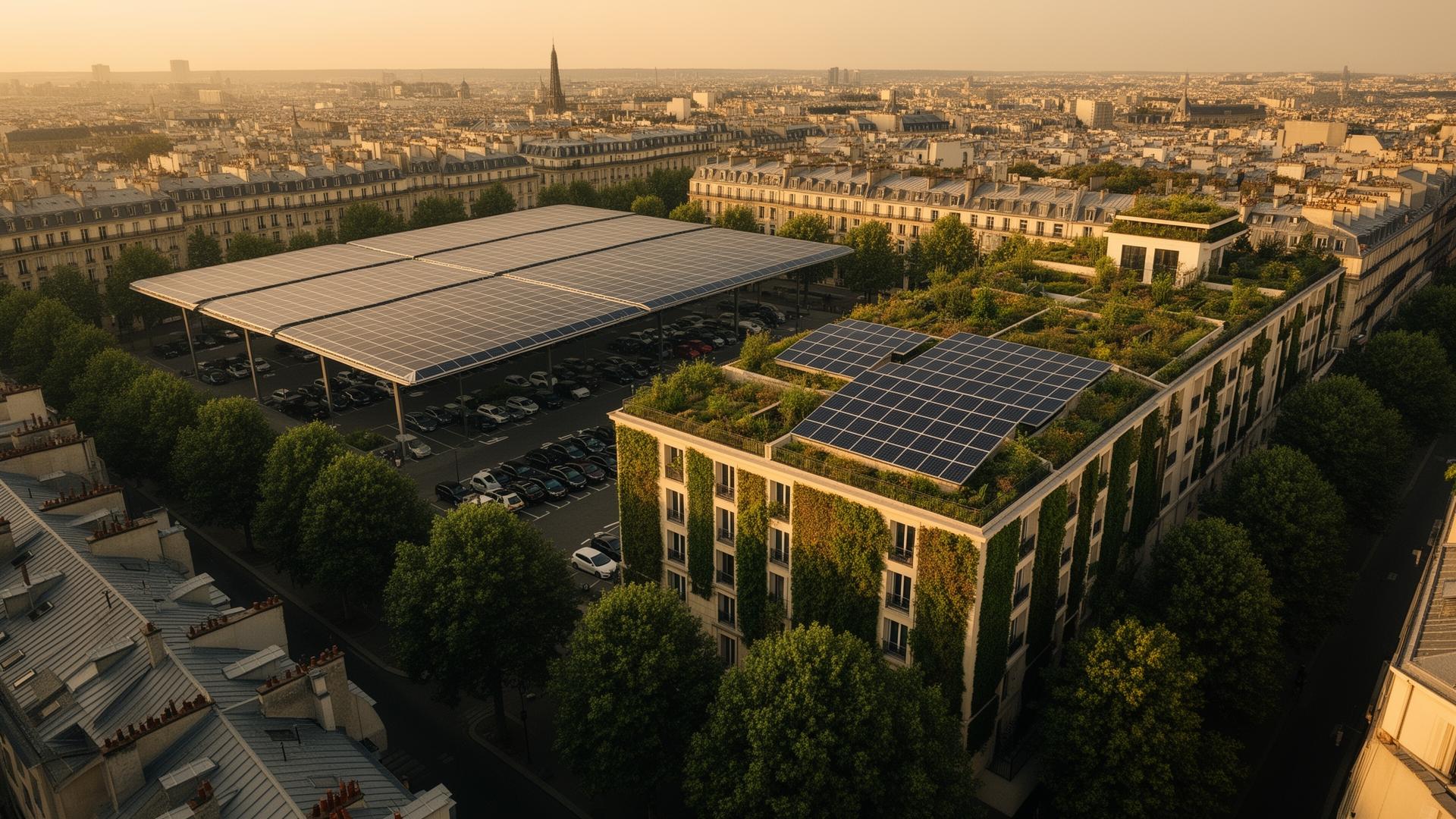
Here is the single idea the whole productive city runs on: every surface should do more than one job. A roof should not merely keep rain out — it should generate power, capture water, grow food, host a landing pad. A parking lot should not merely store cars — it should produce energy, shade the ground beneath it, and harvest the rain that falls on it. A facade should not merely hold up a window — it should collect light, buffer heat, breathe.
We have spent a century building single-purpose infrastructure, and single-purpose is a synonym for under-used. Dual-use is not a clever optimisation at the margins. It is a fundamental rethink of what a surface is for. Once you see it, you cannot un-see how much of the city is asleep on the job.
Single-purpose is just a polite word for under-used. Every surface should do more than one job.
The Roof and the Parking Lot
Two surfaces dominate every city, and both are spectacularly under-employed. The rooftop is the single largest surface a building owns — and across an entire city, the largest unused real estate there is, doing exactly one job: keeping rain out. The parking lot is its horizontal twin: vast, dark, sun-baked acres dedicated to storing stationary metal under open sky.
Together they represent an astonishing share of the urban surface, already built, already connected to the grid and to demand, already paid for — and almost entirely wasted. This is not a tragedy. It is the opportunity. The productive city's fastest, biggest wins are sitting in plain sight, on top of and beside every building we already have. We don't need to find new space. We need to wake up the space that's been napping above our heads and beneath our cars.
This is exactly the wager behind two ventures in our own portfolio. Parkinglot Category turns the lazy parking lot into a solar canopy that generates power, shades the asphalt and catches the rain — all on land the city already sealed. FreeRoof turns the dead rooftop into an energy-producing surface, financed so the building owner never has to choose between a sound roof and a power plant. Same principle, two surfaces: take what already exists and make it work.
When Infrastructure Wakes Up
A productive surface generates something — power, water, shade. But the leap happens when those surfaces start talking to each other. A roof that makes electricity is useful; a roof that knows when the building below needs it, when the grid will pay most for it, and when the battery in the basement should hold it instead — that is infrastructure that thinks.
Multiply that across a district and the static city becomes a responsive one: surfaces sensing, balancing and trading in real time, with no human issuing commands. The pipes and wires of the old city were dumb conduits, laid once and forgotten. The infrastructure of the productive city is alive — it produces, it senses, it negotiates. We are not just upgrading what surfaces do. We are giving the city a nervous system.
The pipes of the old city were dumb conduits. The infrastructure of the productive city is alive — it produces, senses, and negotiates.
The Practical Radicalism of Reuse
Critics will call dual-use modest — retrofitting roofs and parking lots instead of building gleaming new eco-cities. They have it backwards. Building a new city from scratch is the fantasy; it is slow, ruinously expensive, carbon-heavy, and it leaves the existing city — where everyone actually lives — exactly as wasteful as before.
Upgrading what already stands is the radical move precisely because it is the realistic one. It is faster, because the structures exist. It is cheaper, because the land is bought and the grid is connected. It is lower-carbon, because the most sustainable building is the one you don't demolish. And it scales, because there is a lazy roof and an idle parking lot in every neighbourhood on Earth. The productive city is not a place we will go someday. It is the city we already have, finally pulling its weight.
Building a new city from scratch is the fantasy. Upgrading what already stands is the radical move — precisely because it's the realistic one.