Who Owns the Energy, Controls the AI
Follow the chain and it leads to one place. Artificial intelligence needs data centres. Data centres need energy — vast, relentless, growing rivers of it. And so the real question of this century is quietly disguised as a technical one: who owns the energy, controls the AI.
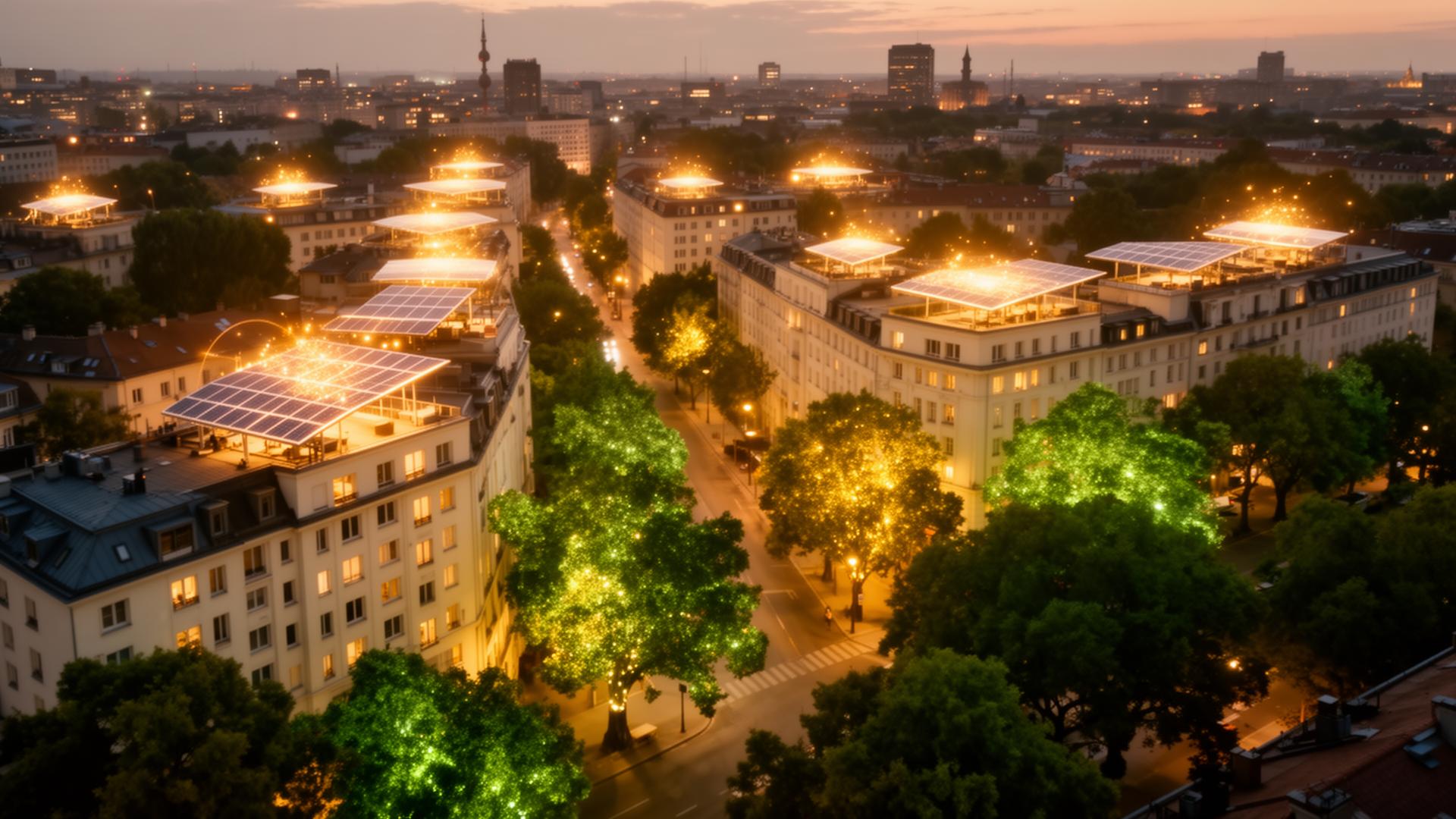
For a moment it looked as if the answer would be a handful of giants — whoever could build the biggest plant next to the biggest server farm. But the productive city points to a different answer. When every rooftop, every canopy, every parking lot generates power, ownership of energy is no longer concentrated — it is distributed across millions of surfaces and the people who own them.
Distributed energy is not just an environmental choice. It is a question of who holds power, in both senses of the word.
AI needs data centres. Data centres need energy. Who owns the energy, controls the AI.
When Power Stops Being Scarce
Imagine the moment energy becomes too cheap to meter. Rooftop and canopy solar, paired with storage that finally got cheap, already push districts toward self-sufficiency. Now extend the line. Fusion — endlessly promised, finally arriving — does not land as one giant national reactor but, eventually, as something small enough to sit in a basement, a block, a community.
A neighbourhood with its own compact reactor. A building that is its own utility. When generation collapses to the scale of the home and the street, the price of a kilowatt-hour falls toward zero, and the entire logic of the economy built on energy scarcity quietly inverts.
We spent a century optimising how to ration power. The next century is about what becomes possible when you no longer have to.
We spent a century optimising how to ration power. The next is about what's possible when you don't have to.
Free Energy, Priced Services
Here is the counter-intuitive part: when energy itself approaches free, it doesn't disappear from the economy — it moves underneath it. Energy becomes the primary layer on which every service is built, the way bandwidth became the invisible substrate of the internet. You will not buy electricity; you will buy what electricity makes effortless.
Mobility that arrives because moving you costs almost nothing. Heating and cooling that simply happen, because comfort is no longer rationed against a meter. Water captured, cleaned and recirculated, because the energy to do it is ambient and free. Computation — the AI woven through daily life — running locally because the power to run it is already there, on your roof, in your block.
The business model of the productive city is not selling energy. It is selling everything that abundant energy unlocks, with the energy itself folded invisibly into the price, or into nothing at all.
The Grid That Trades Itself
With millions of tiny producers, the grid stops being a one-way pipe and becomes a marketplace. Every rooftop is a seller; every battery, every EV, every building is a trader. Energy flows where it is needed and settles in real time, machine to machine, in fractions too small and too fast for any human to manage — so they aren't managed by humans at all.
Picture an open ledger where a surplus kilowatt-hour from your canopy at noon is automatically sold to the data centre across the district, and the value lands back in your wallet as a token before you've finished your coffee. The neighbourhood becomes a tiny, self-clearing energy economy.
The utility company, as we knew it — a monopoly selling a scarce thing through a single wire — simply has no role left to play. What replaces it is closer to a protocol than a corporation.
The utility was a monopoly selling a scarce thing through a single wire. What replaces it is closer to a protocol than a company.
And It Starts on a Roof
None of this requires waiting for fusion or for the perfect token. The inversion begins with the most ordinary act imaginable: putting generation on a surface that was doing nothing. A solar canopy over a parking lot. An energy-producing roof where a dead one used to be. A battery in a basement.
Every one of these is a small transfer of energy ownership from the few to the many — and the future described here is simply what happens when you do that a million times over. The productive city's most radical idea is also its most boring: stop importing power, and start making it where you already stand.