Let's Not Pretend
Begin with the truth, because anything else is an insult. The climate has already changed — not in some deferred future, but now, measurably, in the lifetime of everyone reading this. Cities feel it first and worst: they trap heat, they flood, they bake. The honest position is not denial and not despair, but the thing in between that actually builds: clear sight. We name the problem plainly, and then we refuse to be paralysed by it.
That is the world we are designing for. Not a hypothetical one. The question is no longer only how to stop the climate changing — it is also how to build cities that thrive while it does. That second question is where the productive city has its sharpest answer.
The honest position is not denial and not despair, but the thing in between that actually builds: clear sight.
Resilience as a Free Byproduct
Here is the move that changes everything. In the old model, climate adaptation is a cost — a sea wall, a bigger drain, a defensive expense bolted on after the fact, delivering nothing on a normal day. The productive city refuses that framing.
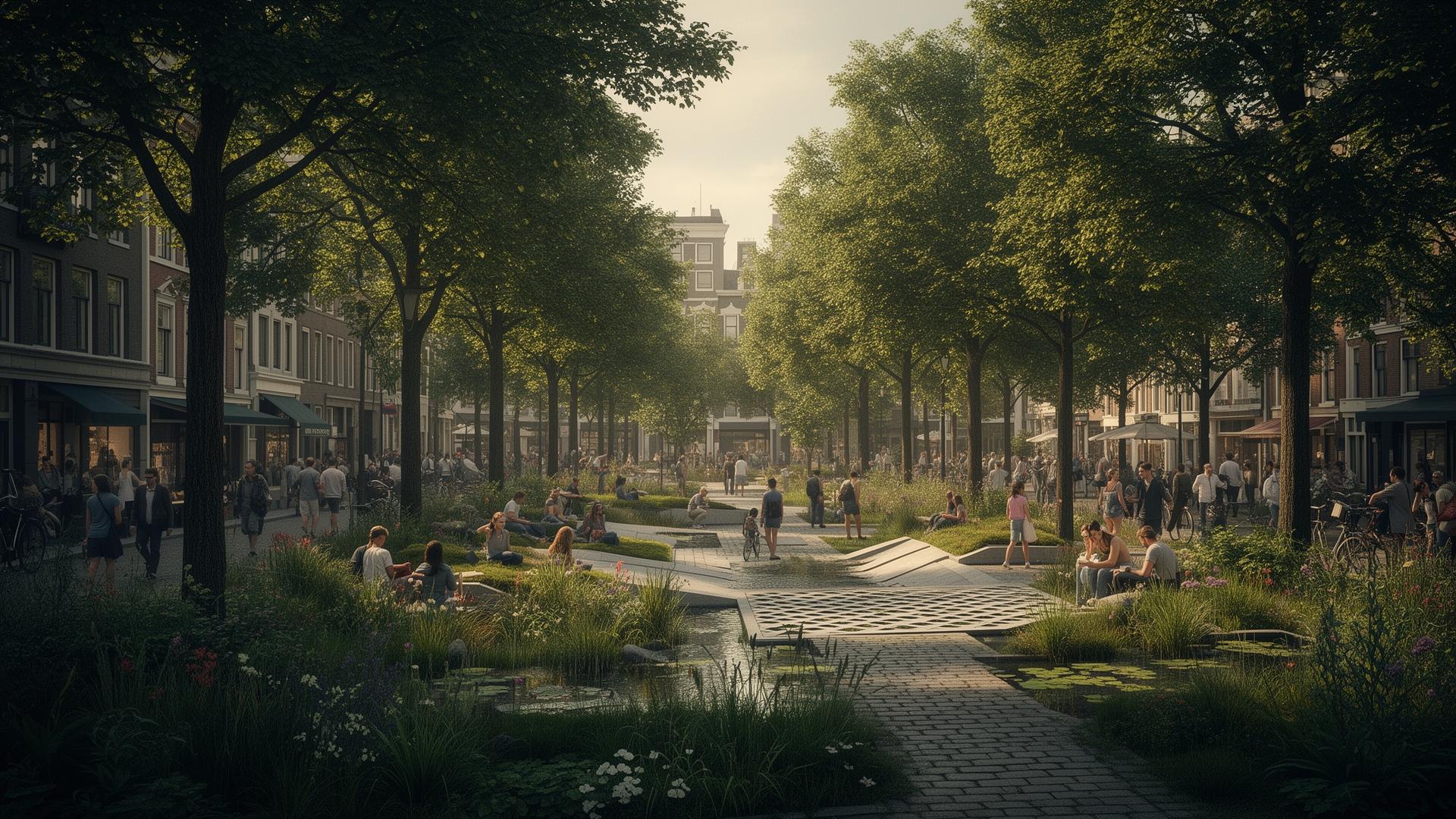
When every surface is already doing a productive job, adaptation comes along for free. The solar canopy that generates power also shades the asphalt and breaks the urban heat island. The green roof that grows food also absorbs the downpour that would have flooded the street. The rain captured for reuse is also rain kept out of an overwhelmed sewer.
You do not pay separately for resilience; it falls out of a city that was built to produce. Adaptation stops being a grudging insurance premium and becomes a byproduct of good design.
You don't pay separately for resilience. It falls out of a city that was built to produce.
Turning Down the Heat
The most immediate climate threat to a city is not the distant sea — it is the heat radiating off its own surfaces, today. Dark roofs and bare asphalt soak up the sun all day and breathe it back at night, turning dense districts into ovens that kill the old, the young and the poor first.
There is no way to un-build a city to fix this. But there is a way to re-skin it. Shade the worst surfaces, green the bare ones, and let canopies intercept the heat before it ever lands. A district that was an oven becomes a place you can stand outside in August.
This is not a far-future dream — it is the single most achievable climate intervention a city can make, and it pays for itself in lives, in comfort, and in energy never spent on cooling.
Making Peace With Water
For a century cities treated rain as an enemy to be flushed away as fast as possible — straight into pipes that a changing climate now overwhelms. The productive city makes a different peace. It treats water as a resource to be caught, slowed, stored and reused.
Roofs and canopies become capture surfaces; plazas become sponges; sunken parks double as basins that hold a downpour and release it gently. The same infrastructure that protects the city from the flood also banks the water for the drought — because the future holds more of both.
A street designed to become a river, on purpose and safely, is worth more than a pipe that can only ever fail bigger. Water stops being the thing that destroys the city and becomes something the city is built to hold.
From Less-Bad to Genuinely Good
And now the boldest claim, the one worth staking the whole project on. For decades, urban sustainability has meant doing less harm — emitting less, wasting less, a slower march toward a cliff. That is not enough, and it never inspired anyone.
The productive city aims past it, at something regenerative: a city that gives back more than it takes. A district that generates more clean energy than it uses. That cleans more water than it dirties. That cools its surroundings, grows food, and shelters more life each year than the year before.
Picture a city that the surrounding landscape is glad to have — that improves the air, the water and the climate around it simply by existing. That is the destination. Not a city that merely survives the changing climate, but one that helps heal it. The most radical thing a city can be, in this century, is generous.
The most radical thing a city can be, in this century, is generous — giving back more than it takes.