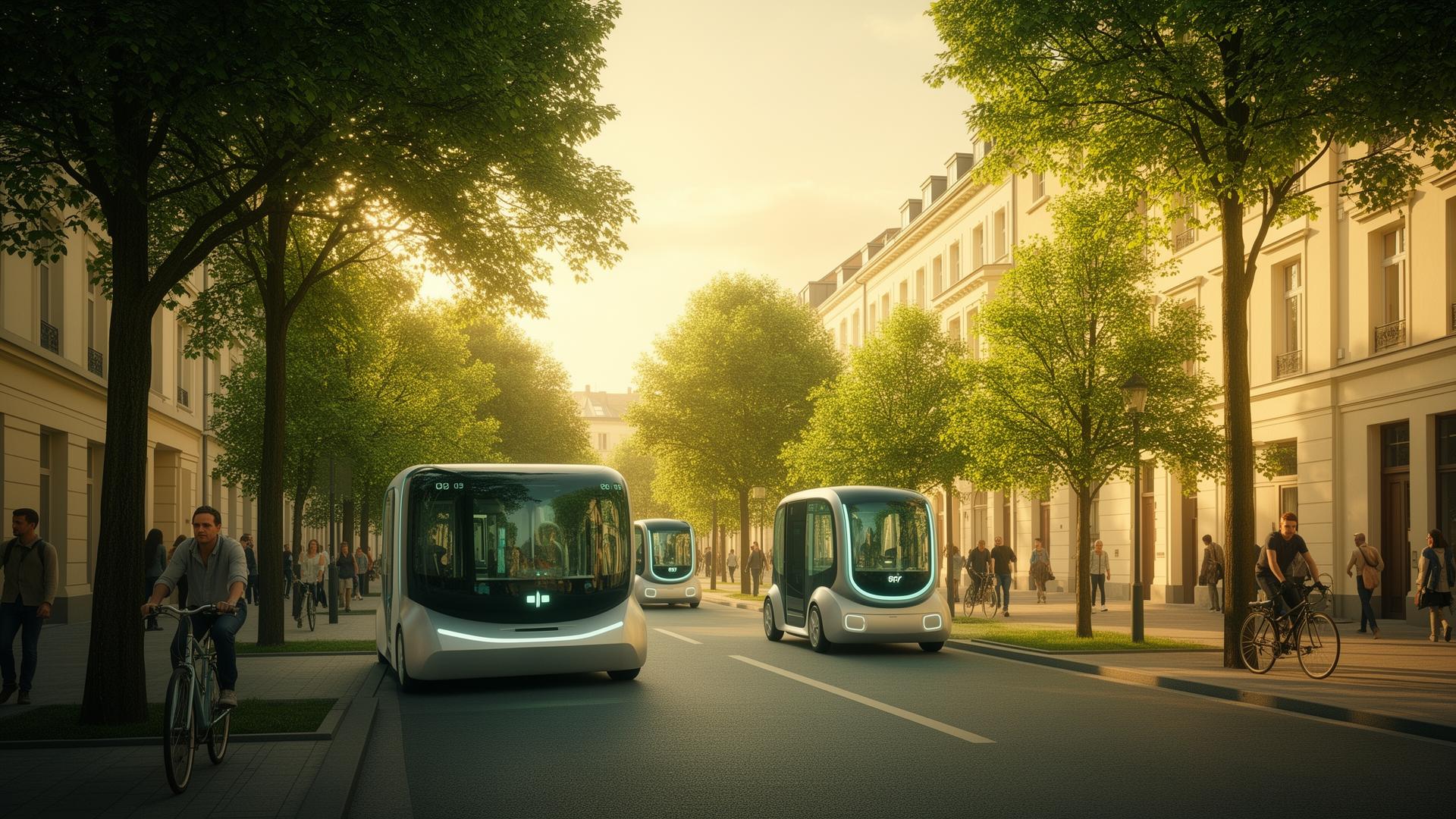
This Isn't a Forecast. It's a Tuesday.
The temptation is to file autonomous mobility under "someday." Don't. While the debate continued, the driverless car quietly became a daily errand for hundreds of thousands of people. The robotaxi is no longer a demo on a closed track — it is a paid ride you hail on your phone, in real cities, right now.
The thing that makes this different from every other future on this site is its speed and its ordinariness. You will not attend the launch of autonomous mobility. You will simply notice, one day, that you haven't driven in a while — and that you don't miss it.
That curve does not flatten — it bends upward. The industry has crossed the line from "can we make it work" to "how fast can we scale it." And scaling, not inventing, is what reshapes a city.
You won't attend the launch of autonomous mobility. You'll just notice one day that you haven't driven in a while — and don't miss it.
The Car That Never Parks
Here is the hidden hinge of the whole thing. A private car spends roughly 95% of its life parked — a two-ton object you buy, insure and store, used a fraction of the time. An autonomous fleet inverts that completely. The vehicle doesn't sit; it circulates, summoned and released, serving one rider after another.
And the moment cars no longer need to be stored, the city's single most wasteful land use — parking — collapses. Not shrinks. Collapses. The kerbside parking, the multi-storey garages, the vast surface lots baking in the sun: all of it becomes surplus, almost overnight, in the densest and most valuable parts of every city.
The car that never parks doesn't just change traffic. It hands the city back its land.
A private car is parked 95% of its life. The autonomous fleet doesn't sit — it circulates. And parking, the city's most wasteful land use, simply collapses.
Half the City, Handed Back
This is where mobility stops being a transport story and becomes a city story. Imagine the freed land all at once: the lanes once given to moving and storing cars, the lots, the garages — a staggering share of the urban surface, suddenly available.
Some returns to soil and trees, cooling streets that used to bake. Some becomes the housing cities desperately need, built where the parking used to be. Some keeps a roof of solar canopies and quietly generates power. The same square metre that stored one stationary car can now grow food, shelter a family, produce energy, or simply let a child play.
Mobility is the key that unlocks the door — but the productive city is what walks through it.
And Then the City Goes Vertical
Once the ground is free, movement discovers the third dimension. Electric aircraft lift and land without runways, threading corridors no human eye can see. At first it's exotic — a medical sample flown across the city in minutes, a time-critical trip for those who can pay.
Then, the way every technology does, it becomes ordinary. The vertiport stops being a glamorous sky-airport and becomes as mundane as a bus stop, woven into the same rooftops that generate the power the aircraft run on.
Distance stops being a flat thing measured in kilometres and becomes a volume measured in minutes. The child born into this city won't think of "up" as somewhere only birds and planes go. They'll think of it as another street.
The Real Prize Is Time and Safety
Strip away the spectacle and the deepest change is human. The hours a commuter once spent gripping a wheel become hours returned — to work, to rest, to family. The streets that once took a grim toll in collisions become dramatically safer when machines that don't drink, don't text and don't tire do the driving.
Mobility stops being a thing you endure and becomes a thing you barely notice, like running water. The productive city's promise here is almost gentle: get where you're going, safely, without it costing you your attention, your money, or your land.
We organised an entire century of city-building around the private car. We are about to discover how much of the city we can have back.
We organised a whole century of city-building around the private car. We're about to discover how much of the city we can have back.