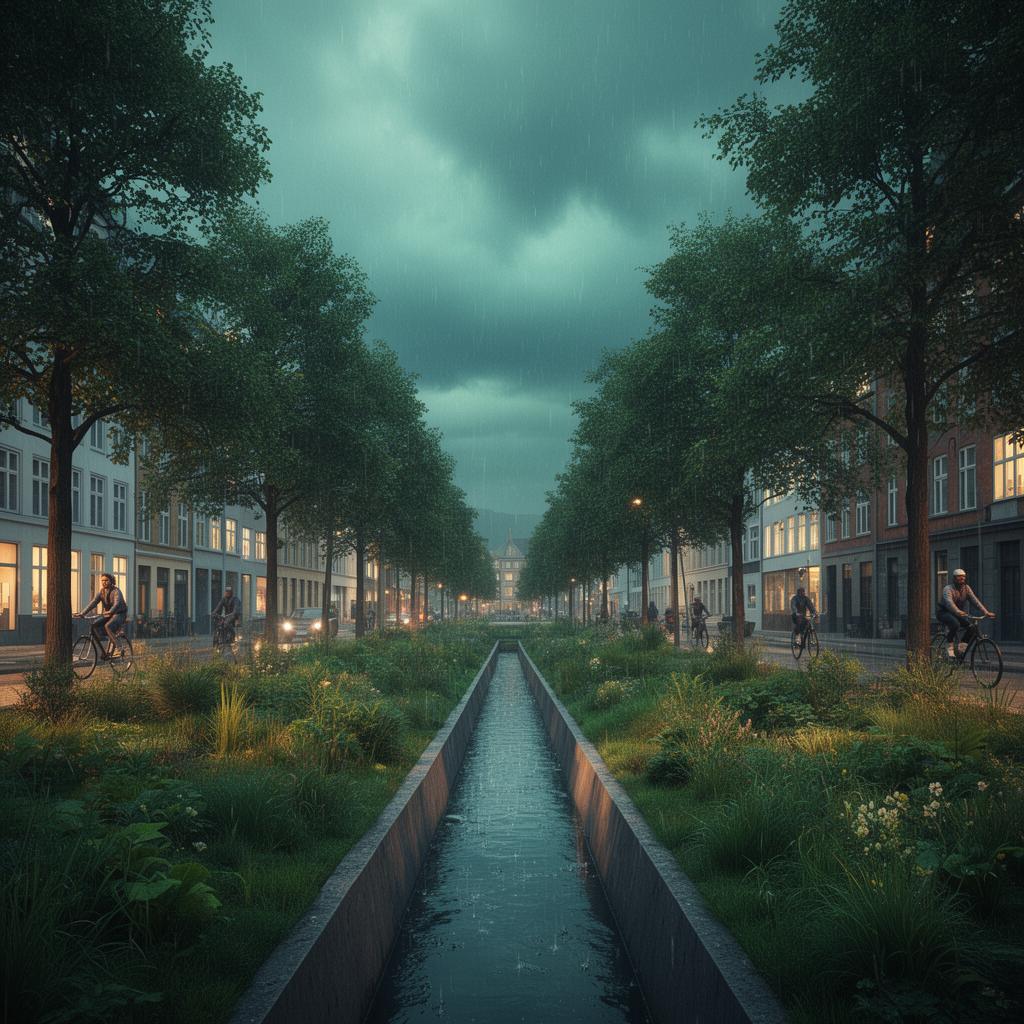
The day the pipes lost
In July 2011 a single cloudburst dropped around 150 mm of rain on Copenhagen in roughly two hours and caused close to €1 billion in damage. The conventional answer — bigger underground pipes — was both ruinously expensive and slow. Copenhagen chose a different path: design the surface of the city to handle water.
A plan at city scale
The 2012 Cloudburst Management Plan, part of the wider Climate Adaptation Plan, sets out roughly 300 projects over about 20 years across seven catchment areas. The strategy is “blue-green”: parks and natural areas that absorb and store rainwater, plus cloudburst boulevards engineered with a V-shaped profile and raised kerbs so that, in extreme rain, the water runs down the middle of the street and away from buildings. Streets become rivers — by design, safely. The goal is protection against a 100-year rainfall and decoupling 30–40% of stormwater from the combined sewer.
The smartest flood infrastructure is the kind you'd want even when it isn't raining.
Multifunctional by principle
Because extreme downpours are rare, every intervention must earn its keep on ordinary days too. Sunken playgrounds double as retention basins; tree-lined boulevards channel water while providing shade and cooling; seven large tunnels — each able to hold roughly 10,000 m³, the volume of four Olympic pools — handle both rare cloudbursts and the increasingly common overloaded-sewer days. This multifunctionality is the productive-city principle in its purest form: every asset has more than one job.
It pays
The roughly €1.3 billion programme is not charity — a socio-economic analysis found the benefits far exceed the costs, with a net benefit cited at around $767 million, and a related Ramboll study in New York found every $1 invested in blue-green infrastructure returns about $2. In the Saint Kjelds pilot district, turning about 20% of the neighbourhood into green space allowed roughly 30% of stormwater to be managed locally.
Lessons for 2040
Copenhagen reframed climate adaptation from a cost to be minimised into infrastructure with a positive return. For a productive city, the lesson is that resilience and livability are the same investment when designed together. The water that once destroyed the city is now a resource the city is built to handle — and increasingly, to keep.