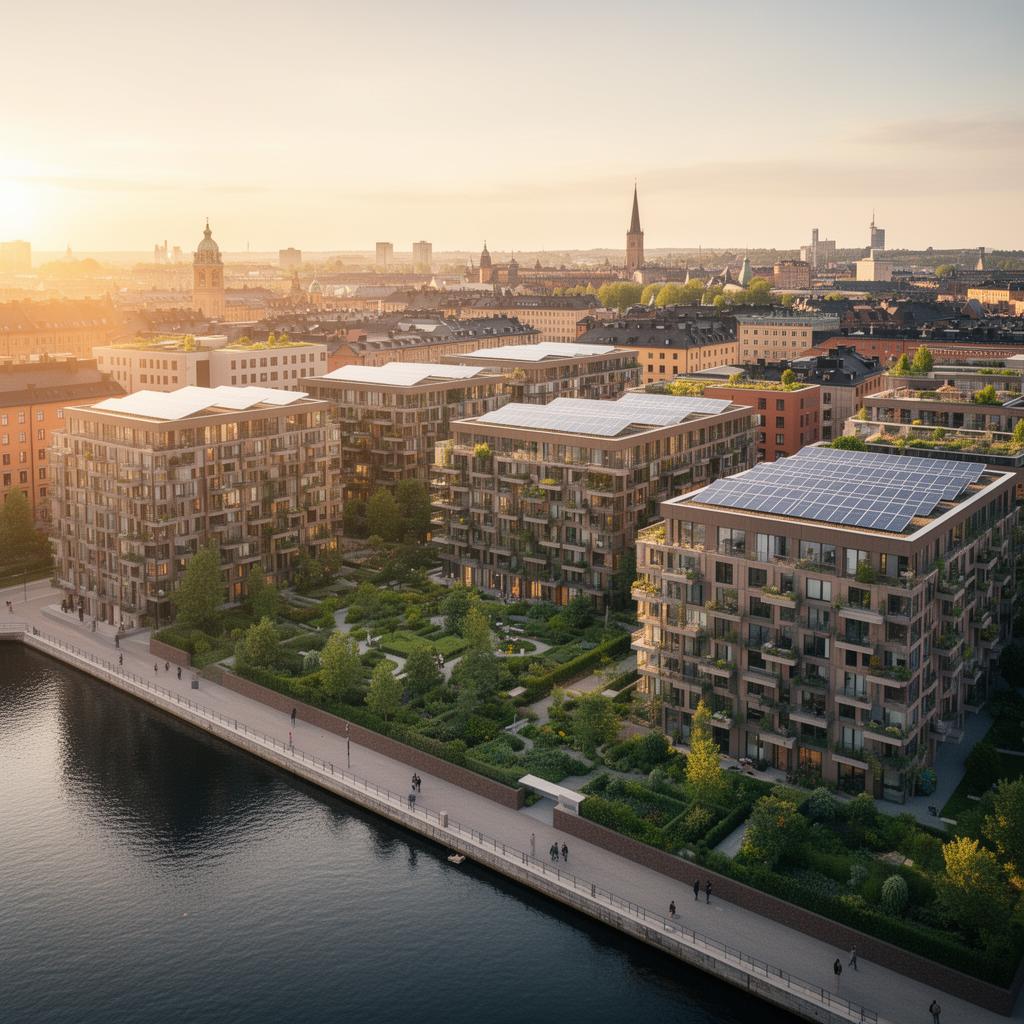
From oil depot to testbed
In 2009 Stockholm City Council made a deliberate choice: the old Royal Seaport, a brownfield port site, would become a model for sustainable urban development and a testbed whose job was to generate and spread knowledge. Fifteen years on, it is one of the few districts in Europe with a decade-plus of measured operational data rather than glossy projections.
The numbers, measured not modelled
The district set demanding energy requirements and then did the harder thing — it followed up. Measured energy use averaged around 68 kWh/m² for residential buildings and 54.9 kWh/m² for new commercial space. A site-allocation competition produced a pilot set of plus-energy buildings that beat the requirement by 42%, a result attributed to good form factor and well-executed technical installations. In the historic Gasverket buildings, retrofits cut energy use by roughly 57% against initial calculations.
It doesn't matter if energy requirements are set, as long as they aren't followed up.
The honest finding
The most valuable output is not a headline number but an admission: calculated energy use repeatedly differed from measured consumption, largely due to quality-control gaps during construction. This is the single most underreported truth in sustainable building, and Stockholm Royal Seaport made it visible by measuring. Through the Cities4PEDs collaboration with Brussels and Vienna, the district also found that supplying local heating and cooling is achievable, but producing all the electricity the area needs remains expensive with current technology.
Productive, not just efficient
Crucially, the district treats energy at the system level, not the building level — combining low-energy construction, local solar (895 MWh on-site in 2022), waste-energy recovery, and motion-controlled LED street lighting that halves lighting energy. That systemic framing is exactly what separates a “green building” from a productive district.
Lessons for 2040
The Royal Seaport proves the productive-district concept is real and measurable — but it also exposes the binding constraint: the gap between designed and delivered performance. For 2040, the lesson is that monitoring is not paperwork; it is the mechanism that turns ambition into outcomes. A city that does not measure cannot become productive.